 Mantra zone
Mantra zone separates action inputs from signing authority and recovery ownership
Mantra zone separates a job into the inputs you choose, the request your wallet signs and the available recovery path if something goes wrong. Staking needs a validator and amount; swaps need an input, desired output and acceptable execution terms; liquidity needs assets and pool position terms. Connecting an account reveals its public address, which lets the interface read balances for that address on the selected network. Only a transaction approved in the wallet and broadcast to the network can request an on-chain change.
Start with the action's real inputs
Each route builds a different transaction from the account, assets and choices supplied through the interface. Those inputs determine the requested state change. A wallet signature authorizes that request; it doesn't correct an unsuitable validator, reversed asset direction or unintended pool selection. Check those inputs before opening the wallet prompt.
Validator delegation
A delegation request combines a MANTRA amount with a selected validator. The available balance must cover both the delegation and its network fee. Commission, displayed annual percentage rate and existing delegation size can inform the choice, but they aren't part of a fixed return promise. The expected result is a delegation recorded for the signing account and chosen validator.
Swap instructions
A swap request needs an offered asset, an amount and the asset to receive. Its execution conditions may also include a minimum received amount or maximum spread. The displayed quote is an estimate before execution, while the signed message contains the enforceable transaction terms. A reversed input and output changes the trade rather than merely changing how it appears.
Liquidity contributions
A liquidity request identifies the pool and the assets entering it. Slippage limits affect whether the transaction can execute. An optional position lock affects when the resulting position can be withdrawn. Supplying liquidity creates a pool position rather than a simple token exchange, so ownership is evidenced by the recorded position or LP shares assigned to the account.
Connection, approval and signature boundaries
Wallet connection and transaction authority are separate permissions. A connection lets the interface identify a public account and read its visible on-chain state. It doesn't move funds by itself. The seed phrase and private key remain wallet secrets and shouldn't be entered into a website connection prompt.
On MANTRA Chain, a Cosmos signature covers the entire Cosmos transaction while an EVM signature covers the EVM transaction itself. That difference matters when reviewing a prompt. A Cosmos request may contain multiple messages, while an EVM transaction stands alone. If an EVM route uses an ERC-20 token, a separate approval may grant a contract an allowance before the requested contract action can use that token.
An allowance isn't the same as a swap or liquidity deposit. It authorizes token spending up to the displayed scope, while the later contract call requests the actual state change. The signing account owns the decision to approve, reject or reduce that permission where the wallet supports editing it.
What does each wallet request authorize?
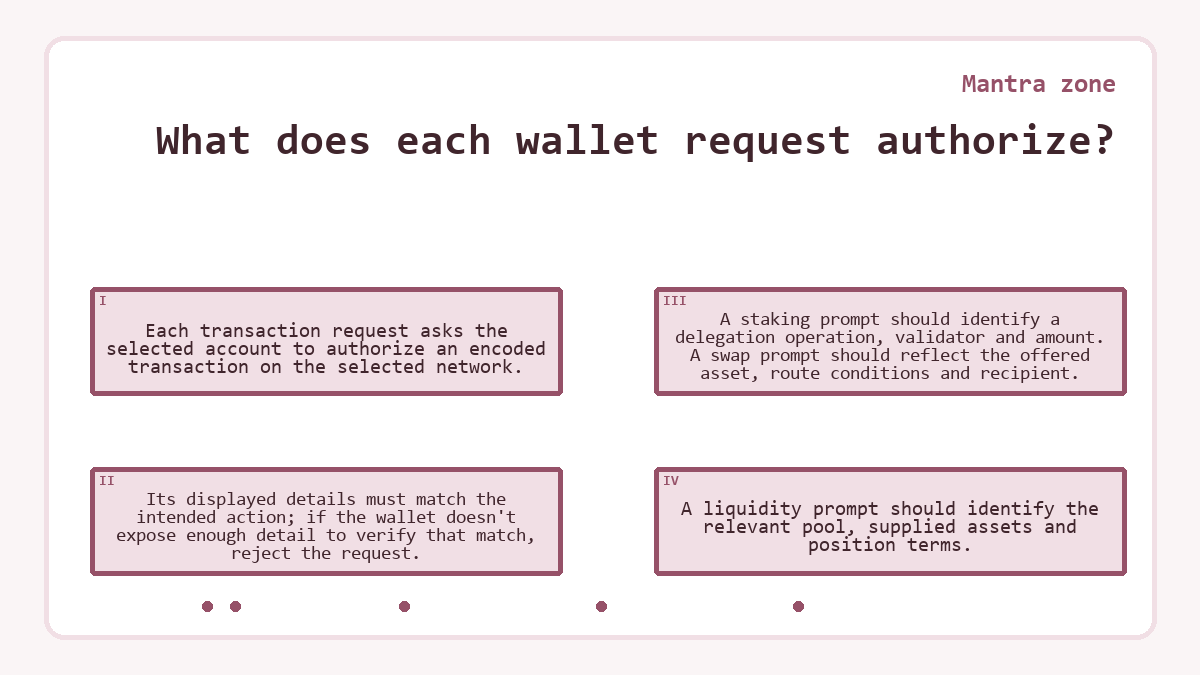
Each transaction request asks the selected account to authorize an encoded transaction on the selected network. Its displayed details must match the intended action; if the wallet doesn't expose enough detail to verify that match, reject the request. A staking prompt should identify a delegation operation, validator and amount. A swap prompt should reflect the offered asset, route conditions and recipient. A liquidity prompt should identify the relevant pool, supplied assets and position terms.
The network fee pays for execution and is separate from the amount committed to the action. Contract addresses, recipients and token allowances deserve their own review because they define who or what receives authority. If the prompt describes a transfer when the intended job is delegation, signing it won't produce a staking position.
How can you tell whether an action changed the chain?
A transaction hash identifies the submitted transaction, but its final status determines whether the requested change executed. Pending means the network hasn't yet produced a final result. Success should be followed by the expected delegation, received balance or liquidity position. Failure means the requested state change didn't complete, although the attempt may still consume a network fee.
The connected account and network should match the transaction record. A successful record under another account won't update the intended account's position. Likewise, an interface that hasn't refreshed may lag behind confirmed on-chain state. Reconnecting or refreshing can fix presentation, but it can't alter the transaction that the network already processed.
Recovery ownership follows the failure point
The point of failure determines who can act next and which remedies remain possible. Before broadcast, control stays with the wallet holder. After broadcast, the network decides execution. Once a transaction succeeds, any reversal must use a supported on-chain operation or depend on the recipient's cooperation. The interface can't erase a confirmed record.
Before broadcast
An unsigned or rejected request hasn't changed on-chain state. The account holder can correct the amount, select another validator or pool and request a new wallet prompt. If the displayed account or network is wrong, changing it before signing avoids creating a transaction under the wrong identity.
On-chain failure
A failed transaction needs diagnosis before another attempt. Insufficient spendable MANTRA, an expired execution condition or a contract rejection can leave the intended result absent. The transaction record and wallet account establish what happened. Repeatedly signing the same request can repeat the same failure and spend another fee.
Confirmed but unintended input
A confirmed action can't be cancelled by disconnecting the wallet. A delegation may later be managed through redelegation or undelegation, subject to staking rules. A completed swap has already exchanged the assets under its signed terms. Funds sent to an unintended recipient don't gain a portal-level recovery path merely because the transfer began in the interface.
A fit check before approving the job
Suppose the job is to turn an available MANTRA balance into a validator delegation and confirm who owns each decision. The route fits only when the account, spendable balance, validator and signing authority are all available. If any prerequisite is missing, stop before signing.
- Confirm that the wallet shows the intended MANTRA Chain account.
- Keep enough spendable MANTRA for the delegation and network fee.
- Match the selected validator and amount to the planned delegation.
- Read the wallet message as a delegation rather than a transfer.
- Use the transaction status and resulting delegation as completion evidence.
When every prerequisite is present
The normal path compares the selected validator and amount with the wallet request, signs once and checks the resulting delegation for the same account. The wallet holder owns input approval. The network owns transaction execution, while the resulting delegation determines which staking management actions remain available.
When one prerequisite is missing
A missing fee balance, account mismatch or different validator in the prompt is a stop condition. Rejecting the request keeps recovery with the wallet holder because nothing was broadcast. If a correctly formed request reaches the network and fails, inspect that result before retrying. A confirmed delegation crosses the recovery boundary and must be changed through supported staking operations.
Trade-offs between staking, swaps and liquidity
Staking, swapping and supplying liquidity differ on the same decision dimensions: required inputs, signed authority, observable result and exit constraint. Staking assigns MANTRA to a validator and produces a delegation. A swap exchanges an offered asset for a requested asset under execution limits. Liquidity provision commits assets to a pool and produces a position tied to that pool's state.
Unstaking starts an unbonding period, and the affected MANTRA doesn't earn staking rewards while that period runs. Redelegation changes the validator relationship without first returning the delegated amount to the spendable balance. These rules make staking a poor substitute for a job that requires immediate access to the same funds.
Swaps finish with a new asset balance and don't preserve a claim on the original input. Liquidity positions remain exposed to changing pool reserves until withdrawal, and an optional farm lock can add an unlocking condition. Choose the route whose resulting state, dependencies and exit rules match the intended job.
What changes when another application handles the next step?
Another application changes the permission and recovery boundary because it can introduce a different interface, contract and support path. Following a link from the ecosystem area doesn't grant the destination a wallet permission. Any existing token allowance remains tied to its original token, spender and network. The destination may request its own connection, token allowance or transaction signature.
The wallet prompt remains the last review point before authority is granted. After execution, the network record shows what the account authorized, while the destination's contract rules govern any position created there. If Mantra zone lacks the required action or prerequisite, a specialized application may fit the job, but its permissions and recovery options must be assessed on their own terms.
Things people ask about Mantra zone
Does disconnecting my wallet cancel a transaction signed through Mantra zone?
Disconnecting the wallet doesn't cancel a transaction that was already signed and broadcast. The network may still process it under the submitted message. Check its transaction status before signing a replacement, because a second request could duplicate the intended action if the first one later succeeds.
How long does a rejected wallet request remain pending?
A request rejected inside the wallet never becomes an on-chain pending transaction because it wasn't signed and broadcast. The interface may continue showing an unfinished prompt until it refreshes, but no transaction hash or network state change should exist for that rejected request.
What should I retain when a Mantra zone action fails?
Retain the transaction hash, signing address, selected network and the wallet's failure message. Those details distinguish a rejected prompt from a broadcast transaction and identify the exact account involved. Never share a seed phrase or private key when seeking help, because neither is needed to inspect a public transaction record.
Why does recovery differ between a completed swap and a liquidity position?
A completed swap has already exchanged the input under the signed execution terms, so there is no open position to cancel. Liquidity provision creates a position that may later support withdrawal, subject to pool state and any locking conditions. Both outcomes follow the confirmed transaction rather than the portal's current display.
Updated